Environment Class 19
BRIEF OVERVIEW OF PREVIOUS CLASS (1:16 PM)
UNCBD (1:24 PM)
- Objective:
- A. Conservation of biological diversity.
- B. Sustainable usage of biological diversity.
- C. Fair and equitable sharing of benefits.
- CBD is implemented by UNEP.
- It is a legally binding convention.
- Two important protocols were signed:
- 1. Cartagena Protocol on Biosafety:
- It is a protocol to CBD agreed in 2000.
- It aims to ensure the safe handling, transportation, and use of Living-Modified Organisms (LMO) resulting from modern biotechnology that may have adverse effects on biodiversity.
- It establishes Advanced Informed Agreement (AIA) procedures for countries to make informed decisions before handling such organisms.
- It also establishes a biosafety clearing house to facilitate the exchange of information on LMOs.
- 2. Nagoya Protocol:
- It aims at sharing benefits arising from the utilization of genetic resources fairly and equitably including appropriate access to genetic resources.
- It was agreed in the year 2010 at Nagoya (Japan).
- Aichi Target:
- It is a strategic plan of 20 biodiversity targets agreed at COP 10 held at Nagoya.
- COP 11 was held in the year Hyderabad, in 2012.
- Kunming-Montreal Protocol Global Biodiversity Framework:
- COP 15, 2020 which was supposed to be held at Kunming was postponed to 2021 and finally held in 2022 in Montreal.
- It aims to achieve the conservation of biodiversity, restore ecosystems, and protection of indigenous rights.
- It has four goals to be achieved by 2050 and 23 targets to be achieved by 2030.
- Goals:
- 1. Halting human-induced extinction of threatened species and reducing by 10-fold, the extinction rate of all species.
- 2. Sustainable use and management of biodiversity.
- 3. Fair sharing of benefits
- 4. Adequate means of implementing the Global Biodiversity framework (GBF) to be accessible to all countries including developing and LDCs.
- Important Target to be achieved by 2030:
- 30 by 30: To restore 30% of degraded ecosystems by 2030.
- To reduce food waste by half by 2030.
- To eliminate or freeze out or reform harmful subsidies.
- Establishment of GBF fund under Global Environment Facility (GEF).
UNCCD (1:58 PM)
- It is an outcome of the 1992, Earth Summit.
- It entered into force in 1994.
- There are 197 members.
- It is the sole legally binding convention linking development and the environment to sustainable land management.
- It aims to protect and restore land and ensure a safer just and more sustainable future.
- It provided the concepts of land degradation neutrality.
- It aims to achieve it by 2030.
- UNCCD COP14 (2019) was held in New Delhi, it resulted in a Delhi declaration on a range of issues related to desertification.
- India set a target of restoring 26 million hectares of degraded land by 2030.
- COP15 was held in Abidjan (Cote- De-Ivoire) in the year 2020.
- The target of COP 15:
- Agreed to exhilarate the restoration of 1 billion hectares of degraded land by 2030.
- The global pledge to boost drought resilience and invest in land restoration for future prosperity.
- Ensure women's involvement in Land management for effective land restorations which was incorporated as the Abidjan Declaration on Gender Equality and Land Restoration.
- Hence, India became the only country that hosted all three COPs i.e. UNFCC, UNCCD, and UNCBD.
SUSTAINABLE DEVELOPMENTS (2:13 PM)
- Sustainable development is a development that meets the needs of present generations without compromising the ability of future generations to meet their own needs.
- Component of sustainable development:
-
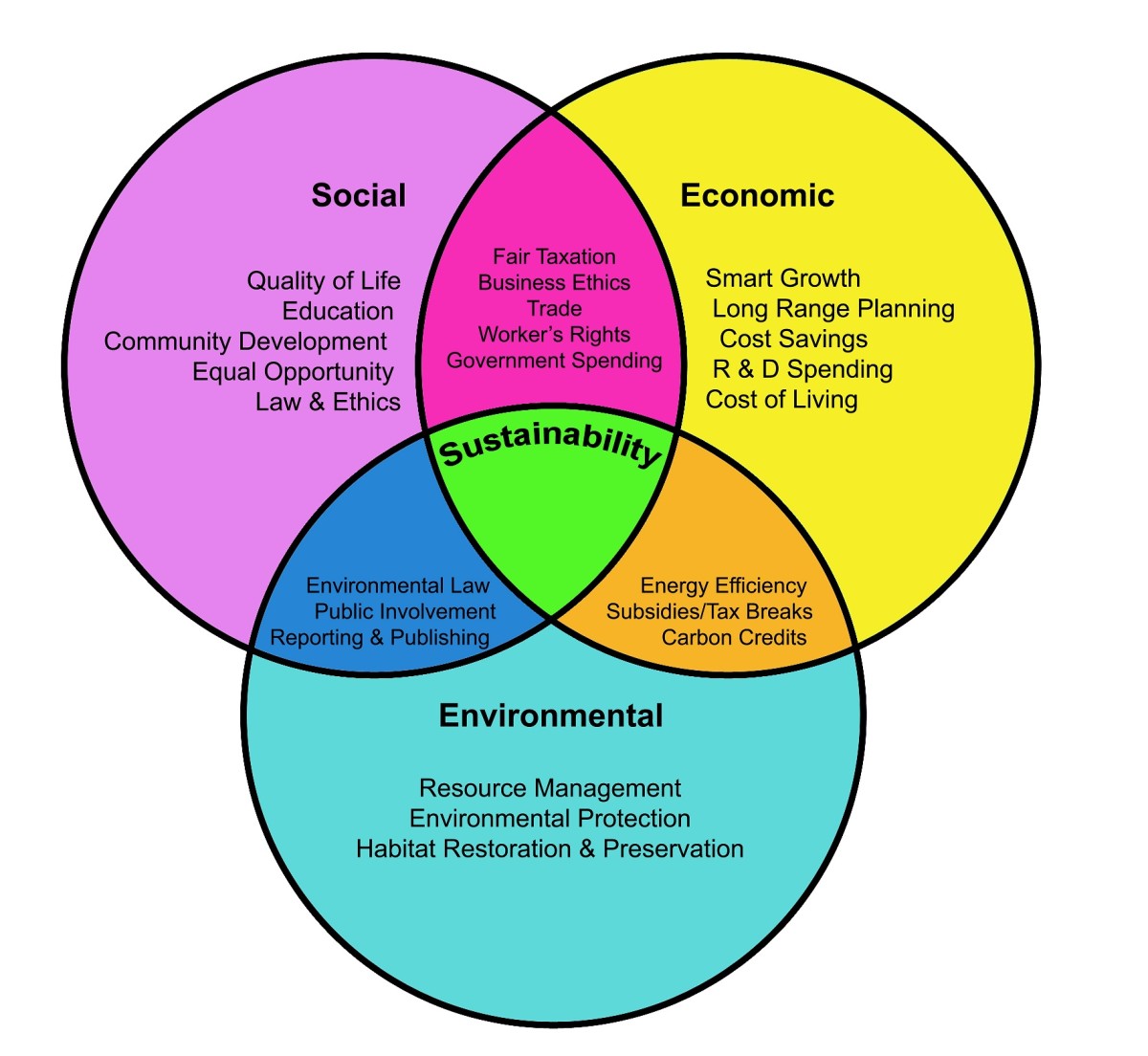
- There are three components i.e. economics, social and environmental sustainability
- Economics sustainability- decisions are made in the most equitable and fiscally sound way possible while considering the other aspects of sustainability
- Social sustainability- providing enabling conditions for everyone to have the capacity to realize their needs.
- Environmental sustainability- maintaining ecosystem integrity and carrying capacity of the natural environment
- Why sustainable development?
- There should be growth with equity.
- Intergenerational equity.
- Environmental conservation.
- Reduces the loss of biodiversity.
- Increases resource utilization and efficiency.
- Increases ecological and environmental productivity.
- Reduces ecological footprints and helps us to live within the carrying capacity of the earth.
- Ecological Footprint:
- The ecological footprint is the biologically productive land and sea area needed to provide the resources that a population consumes and observe the waste it generates
- It is measured using a unit of global hectares (GHA)
- In most of the industrial nations, the ecological footprint varies between 8 to 4.
- For example, in the USA it is 8 GHA, in Japan - 4.7 GHA, and in India, it is 0.9 GHA.
- Earth overshoot day:
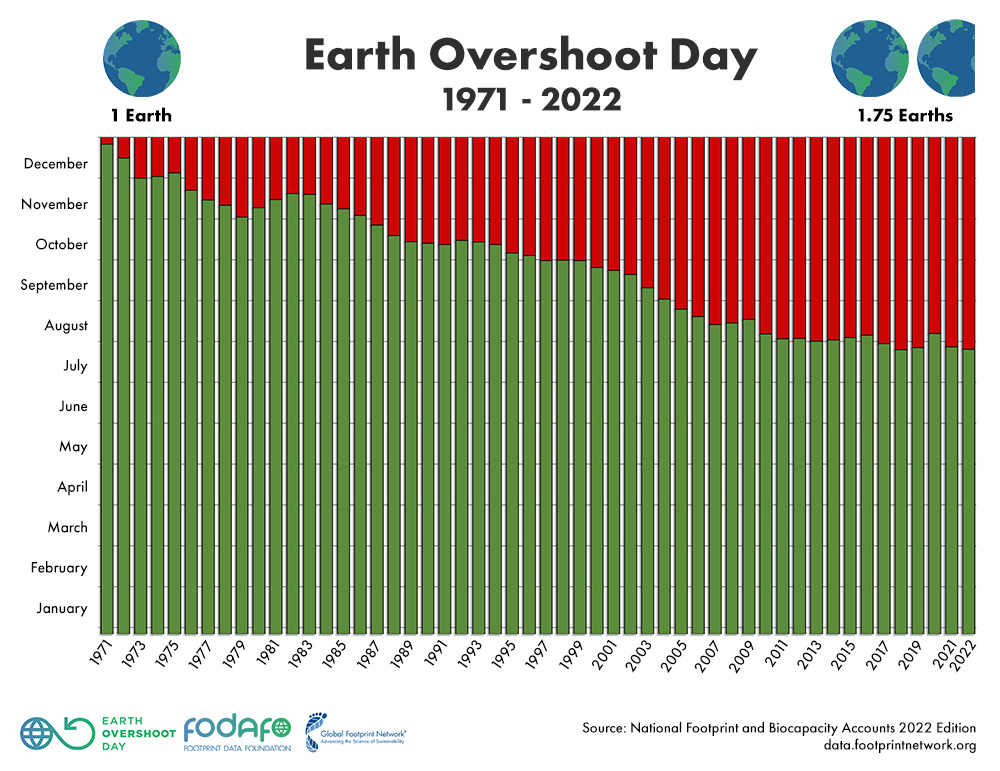
- The Global Footprint Network published an ecological footprint report which estimates the earth's overshoot day in 2022 which was July 28.
- Each year, Earth Overshoot Day marks the date when humanity has used all the biological resources that Earth can renew during the entire year.
-
- Carrying Capacity:
- The carrying capacity of an environment is the maximum population size of a biological species that can be sustained by that specific environment, given the food, habitat, water, and other resources.
- It is the size of the population that can be supported by the ecosystem indefinitely by its supporting system.
INITIATIVES (2:56 PM)
|
Year |
Initiatives |
|
1798 |
|
|
1972 |
|
|
1972 |
|
|
1987 |
|
|
1992 |
|
|
2000 |
|
|
2002 |
|
|
2012 |
|
|
2015 |
|
DIFFERENCE BETWEEN MDG & SDG (3:30 PM)
| MDGs | SDGs |
| There are 8 goals and 21 targets | There are 17 goals and 169 targets |
| MDGs involve narrow consultation | SDGs wider consultation while framing the goals |
| MDGs are only for developed and less developed countries | SDGs are for all countries |
| MDGs majority target economic developments | SDGs have much broader goals including social and environmental targets too |
| In MDGs, there is no important role for civil service organization (CSO) | There are important roles for CSO. |
ENERGY (3:49 PM)
- They can be classified as primary and secondary types
- Primary are found in nature and can be used directly.
- For example: coal, wood, and natural gas
- Secondary is not found in nature and is produced from primary source
- For example: syngas and electricity, etc
- They can also be classified as conventional and non-conventional.
- Conventional: a well-developed method of utilization is available. For example- coal, petroleum, hydropower
- Non-conventional: the method of utilization is not well-developed. For example- solar, wind etc
- They can also be classified as renewable and nonrenewable
- Renewable: An inexhaustible source of energy in the human timeline. For example- solar, wind, hydro and geothermal, etc
- Non-renewable - these deplete with time for eg fossil fuels
- Note:
- Kindly refer to the handouts provided by the faculty for a holistic understanding of the above topics.
- Please note, that the information provided in the handouts is based on data up to 2022. For the most recent figures on energy-related topics kindly refer to the power ministry and update it accordingly.
SUSTAINABLE AGRICULTURE (4:08 PM)
- Sustainable Agriculture:
- It is a method of agriculture involving balanced management of resources available on the farm without compromising the ability of the future to do so.
- Organic farming:
- Agriculture production systems which avoid or exclude synthetically manufactured inputs such as chemical fertilizers, chemical pesticides etc. It relies upon the organic method of cultivation only.
- Natural farming:
- It is an ecological farming approach involving no human input and adopts nature's production method.
- It involves the following principles:
- No-tillage
- No-sowing
- No-pesticides
- No-weeding
- The inputs used for sustainable and organic farming:
- For nutrient management:
- Vermicompost, green manure and Bio-fertiliser.
- Weed management:
- Through mulching, tilling and drip irrigations.
- Using organic pesticides and fungicides. For example - Neem, Pongamia
ISSUE WITH ORGANIC FARMING (4:28 PM)
- Low production in the initial use.
- Costly inputs if it is not available on the farm.
- Farmer requires proper training.
- Marketing of agricultural produce.
- Labelling and certification: It is either costly or too technical and not easily available.
- Note:
- Certification is given by National Programmes for Organic Production (NPOP) and Participatory Guarantee systems.
ZERO BUDGET NATIONAL FARMING (4:37 PM)
- It was introduced by Subhash Palekar.
- There are four components:
- Jivamrita: It enhances the soil microbiomes and is made using cow dung, cow urine and other local ingredients
- Bijamrita: It involves seed treatment using microbial seed coating.
- Acchadana: It involves cover crops and mulching
- Whapasa: It involves soil aerations
- Vertical farming:
- It is cultivating and producing crops in vertically stacked layers and vertically inclined surfaces.
- It involves Aeroponics.
- Aeroponics:
- It involves growing crops without any growing medium and spraying of missed and nutrient solution directly to plant roots.
- Hydroponics:
- It involves growing crops in water without soil and continuously pumping the water rich in mineral nutrients.
- Aquaponics:
- It integrates aquaculture with hydroponics where nutrient-rich wastewater from fish tanks is used for hydroponics.
THE TOPICS FOR NEXT CLASS: SUSTAINABLE AGRICULTURE (CONTINUATION)